Forced Harmonic Oscillator
#physics
Continuing our discussion from Harmonic Oscillator.
The undamped forced harmonic oscillator
We consider a simple case of the driving force, $$F_{d} = F_{0}\cos \omega t$$
Therefore, the equations of motion change to $$\ddot{x} + \omega_{0}^2x = \frac{F_{0}}{m}\cos \omega t$$
By inputting a trial solution of
This equation seems wrong, because the motion seems fully deterministic. There is no arbitrary constants, and therefore no dependence on initial conditions.
Fortunately, this solution is correct, but we have missed a critical constant.
The full equation is $$x(t) = \frac{F_{0}}{m} \frac{1}{\omega_{0}^2 - \omega^2} \cos \omega t + B\cos(\omega_{0} t + \phi)$$
Where the second term is the equation of motion for the undamped free oscillator.
If this was damped, then
Resonance
The equation for displacement suggests that
Indeed,
The equation for
What does a negative amplitude mean?
It just means that the amplitude has a phase different of
Forced damped harmonic oscillator
Combining all the previous discussions, we have equation of motions for this case is $$\ddot{x} + \gamma \dot{x} + \omega_{0}^2x = \frac{F_{0}}{m}\cos \omega t$$
We try to convert to imaginary systems and come up with a solution
We consider the driving force,
Trial solution is clearly of the form:
and we obtain the complex solution $$\tilde{A} = \frac{F_{0}}{m} \frac{1}{{ (\omega_{0}^2 - \omega^2) + i\omega \gamma }}$$
The amplitude of this imaginary quantity, is the amplitude of the oscillation, which is $$|\tilde{A}| = A = \frac{F_{0}}{m} \frac{1}{\sqrt{ (\omega_{0} - \omega^2)^2 + (\omega \gamma)^2 }}$$
and the phase lag, (where
The final solution can be written as of the form $$x(t) = Ae^{(i\omega t + \phi)} \tag{2.1}$$
Note that in accordance to our discussion on damped harmonic oscillators, the solution in this case, is sinusoidal, but it need not be. The differential equation can give rise to other solutions as illustrated in Harmonic Oscillator.
So, in all accordance, since this is a non-homogeneous second order differential equation, as we have studied in Non-homogeneous second order ODE, the total response is made of two responses, the particular solution and the general solution.
What I've mentioned above is the trivial analysis of the system, and while equation
The full response would also include the particular solution
A more detailed analysis of the solution to that variation of the problem can be found in Harmonic Oscillator
The dependence of
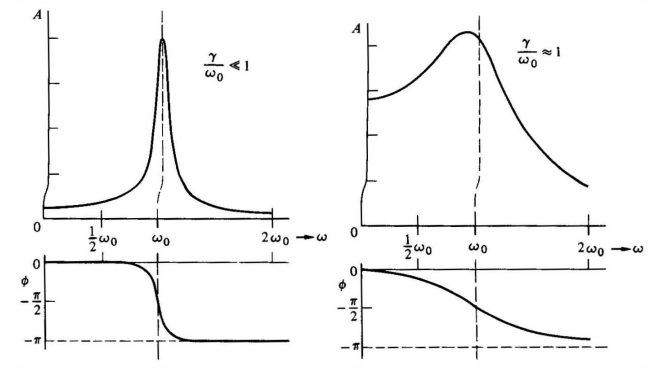
Note that as
Resonance
The amplitude resonance comes from minimizing the denominator in the amplitude expression. Differentiating and formulating the result gives : $$\omega_{r} = \sqrt{ \omega_{0}^2 - \frac{\gamma^2}{2} }$$
Note that the peak of resonance is left-shifted as compared to the natural frequency. The larger the damping, the more left it shifts, the lower the peak is, and the more broad the distribution becomes.
Phase resonance
If we set
So, at this point, displacement lags driving force by