Relativity
The note introduces us to the concept of transformation of coordinates, and how they behave with near lights-peed movement.
Under Galilean transformations, for a frame
This means that time flows uniformly for everyone, and the fundamental laws of mechanics holds everywhere.
But this also implies that light has different speed in different reference frames, since velocities are additive.
In the 19th century when electromagnetism came around, Maxwell's equations suggested that $$c = \frac{1}{{ \mu_{0}\epsilon_{0} }}$$also implying that it is invariant, or atleast, under galilean transformations, these equations would change their fundamental forms in different reference frames.
To combat without ditching Galilean transforms, scientists proposed the "ether". An invisible, absolute, stationary medium permeating the universe, through which light travels.
If this were true, Earth's orbit should create an "ether wind", causing light to travel at different speeds, depending on it's relative motion to earth.
In 1887, the Michelson-Morley Experiment attempted to measure this "ether wind", using an extremely precise interferometer.
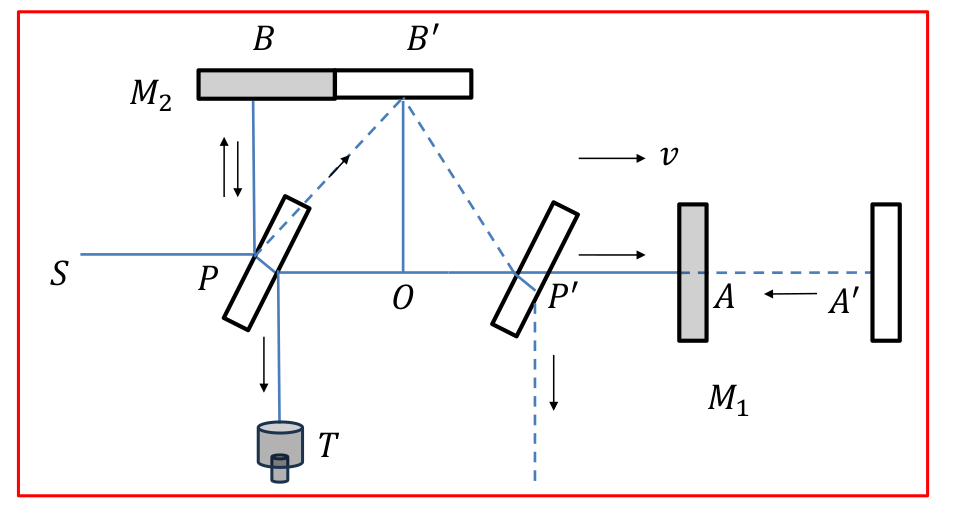
Here,
Skipping the derivations for the experiment because it involves concepts of length-contraction and other relativistic effects
We obtain the time difference as $$\Delta t = \frac{2d}{c} \cdot \frac{v^2}{2c^2}$$
Therefore, we obtain the effective optical path difference as $$\delta = \frac{dv^2}{\lambda c^2}$$
With this, he expected to observe a different fringe shift if the apparatus was rotated in a different direction, but nothing of that sort was observed.
Hence, it was proved that the ether does not exist.
Einstein's Postulates
He came in with an attempt to explain the above stuff, and gave two postulates,
- The principle of Relativity : The laws of physics are the same in all inertial systems. There is no way to detect absolute motion, and no preferred inertial system exists.
- The constancy of the speed of light: Observers in all inertial frames measure the same speed of light in vacuum,
.
Thus with this, Einstein showed that time and space are not continuous, and that they are closely related as space-time.
A direct consequence of this is the problem of simultaneity. Two events that are simultaneous in one reference frame may not be simultaneous in a different moving frame.
Imagine lightning strikes the front and back of a moving train. An observer exactly at the midpoint of the moving train sees the flashes arrive at the same time (
However, an observer on the ground sees the train moving toward the front flash and away from the back flash. To the ground observer, the light from the front arrives first, so the events are not simultaneous (
To deal with this new discovery, Galilean transformations had to be replaced with Lorentz Transformations, which enforces the constancy of the speed of light.
If we consider two frames
Derivation of Lorentz Transform
We assume that light spreads outwards in a sphere in both frames as governed by the equations $$\begin{align}x^2 + y^2 + z^2 &= c^2t^2 \ x'^2 + y'^2 + z'^2 &= c^2t'^2 \end{align}$$
This is basically describing a light-impulse that spreads outwards from origin at
Since we have
Since our light pulse travels with the same speed in both frames, if we consider it's advance only along
Substituting these into our previous relations involving
We multiply the two equations and solve for
Hence we have obtained
Thus the Lorentz Factor is $$\gamma = \frac{1}{\sqrt{ 1-\beta^2 }};\ \ \ \ \beta = \frac{v}{c}$$
To derive the time transform, we substitute the value of
When we want to find the inverse relationships, we simply change the sign of
Thus, the Lorentz Transforms dictate the following, for a boost at speed
Spacetime vector
To describe an "event" in spacetime, we define the spacetime 4 vector : $$X = \begin{pmatrix} ct \ x \ y \ z\end{pmatrix}$$
Then we can define the Lorentz transform between two frames as a simple matrix multiplication.
For a boost along x-axis, the Transform Matrix is denoted by
This matrix preserves spacetime interval, which is the core idea of special relativity.
Essentially, the spacetime interval between two events, is given by $$\Delta s^2 =\Delta x^2 + \Delta y^2 + \Delta z^2 -c^2\Delta t^2$$
If this spacetime interval is transformed to some other inertial frame, then $$\Delta s'^2 = \Delta s^2$$which is the core principle of conservation of spacetime interval
Consequences of relativity
- Simultaneity of events
- Time Dilation : Moving clocks run slower. A clock moving at a speed
will experience time governed by where is the time elapsed in object frame, and is how long has elapsed in a stationary frame. - Length Contraction : Objects lengths contract along the direction of motion. Observed length
where is the true length in a stationary frame. - Invariant spacetime interval.
- Velocity addition nuances : Instead of adding linearly like before, it is governed by $$u' = \frac{u + v}{1 + \frac{uv}{c^2}}$$where
is the velocity of the object in one frame, is the velocity of another frame, and is the observed velocity from that frame. - Mass-energy equivalence : An indirect consequence, it results in the formula we all know so well, $$E = mc^2$$
- Transformation of electric and magnetic fields : Since the two fields are inherently related by Maxwell's equations, they can change form between two frames, ie, a purely electric field may appear as a mix in some other frame.
Time dilation
Any moving object observes time passing at a slower pace, compared to a stationary observer.
If an object moves at a speed
This is not just an extended doppler. The time delay is not due to the fact that a stationary observer will observe two "object-frame" events at different times, because of the time it takes for the event to reach observer. It is more than that.
Length contraction
Consider a spaceship moving towards a target at relativistic speeds.
An observer on ground will notice that it will take time
Since we know $$t' = \gamma t$$this must imply that
Therefore, we have that length of an object in a relativistic frame is related as $$L = \frac{L_{0}}{\gamma}$$
Invariant mass energy
Changing frame of reference will generate an observable difference in momentum and energy, but they are conserved by the equation $$E^2 = (mc^2)^2 + p^2c^2$$
This equation is invariant under all reference frames.
Therefore, for a particle at rest, it implies that
Considering the effects of relativity on velocity, and it's change on rest energy.
In relativity, the total momentum and the total energy of an object are given by $$\begin{gather} \vec{p} = \gamma m\vec{v} \ \ E_{\pu{total}} = \gamma mc^2\end{gather}$$
Therefore, the kinetic energy that a body possesses, solely due to virtue of it's motion, is it's total energy - rest energy, which is $$\pu{KE} = (\gamma-1)mc^2$$
Velocity addition nuances
Consider boost along x-axis, therefore $$\begin{gather} x' = \gamma(x-vt) \ \ t' = \gamma\left( t-\frac{vx}{c^2} \right)\end{gather}$$
Differentiate both of them, considering constant velocity $$\begin{gather}dx' = \gamma(dx - vdt) \ \ dt' = \gamma\left( dt - \frac{vdx}{c^2} \right)\end{gather}$$
Now, since velocity of an object in a frame is $$\begin{gather}u = \frac{dx}{dt} \ \ u' = \frac{dx'}{dt'}\end{gather}$$
Using this knowledge, and dividing equation